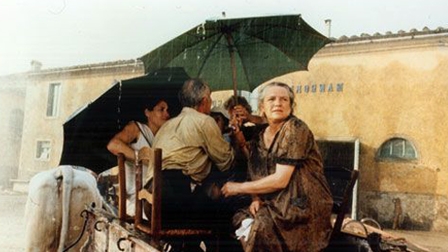
“Neo-Neorealism”
Thursday, May 5, 2011
To Wish Upon a Night of the Shooting Star
The Greatest Supervillain The World Has Ever Known
Revisiting The Bicycle Thief, I really was reminded why this is one of my favorite films of all time. I watched this classic neorealist film a long time ago, way before I even knew what neorealism was and it was the images that stuck with me, which I’m going to share:
Please look at these photos and tell me there’s not something refreshing about the way it looks. I’m usually not a fan of when people say that the setting of the film is an extra character in the film, but in The Bicycle Thief Rome really is a character and a great, multi-layered one at that. As we follow father and son in the simple yet timeless tale of a man losing the classic symbol of a bicycle, which is needed for his job and to provide a stable income for his wife and child get stripped of that by some thief it’s astounding to watch as he perseveres through so much that Rome, the primary antagonist of the film, throws at him and his young son who tags along and provides a sort of superego to his ego (or sometimes an ego to his superego), there is just really something touching about that nature of perseverance. Rome works in mysterious ways, always trying and picking at the man before he finally hits his breaking point, throwing citizens and terrain and buildings and walls at him as challenges that could match any of the great supervillains (Darth Vader and Hannibal Lecter be afraid, Rome’s coming out for you!). But somehow in the sweet melancholy of the film there’s still the feeling of dread that never seems to go away as there always is in life no matter how ready or prepared or happy you feel, something else is always coming for you just around the corner, for The Bicycle Thief, the corners of Rome.
Rome: Opener Is Not Necessarily Better
I think Rome, Open City loves the thought of itself being a neorealist film a little too much. This isn’t to say that I disliked Rome, Open City at all, quite the contrary, I think it’s a brilliant work by Fellini and Rossellini and in my second time viewing it I felt as if I picked up some pieces that I missed the first time that I watched it. What I mean about Open City loving the thought of itself being a neorealist film is that it really found it’s stride in the second half in the torture scene and the raw human emotion that was exhibited was the turning point of the film and it’s greatest moments. But the first half of the film, before the vents that lead up to his scene seemed a little forced to be grounded in reality to the point where we’re just following people. In another great neorealist film and one of my personal favorites that we’re watching next week, The Bicycle Thieves, I was amazed by just how much truth and beauty we can see through the eye-glass that shows life itself by following a simple story, but still just following one man.
Ciao Professore, Ciao Professore
Ciao Professore is a film with plot structures that I’ve seen time and time again. The inspirational teacher story is not difficult to find in America, with films such as Freedom Writers, Lean on Me, Stand and Deliver, The Ron Clark Story, and many others coming to mind the typical inspirational teacher story seems to follow this simple formula:
1) The teacher is an idealistic man/woman with either an experience with good children or just recently got their license and are ready to nourish young minds.
2) The teacher somehow gets placed in a school or classroom with a bad reputation.
3) The students take an almost immediate disliking to the teacher and in many cases try to egg him/her on so that they’ll leave.
4) The teacher very much considers leaving but then takes an alternate route of educating their students.
5) The students slowly get into the teacher’s new methods and slowly become converts.
6) There’s one student who is still unimpressed with the teacher until a situation where the teacher personally steps into their lives in some way, shape, or form and they share an experience that makes the student a convert too.
&
7) They finally become a class.
What do you think, were these kids a breath of fresh air or were they just sickening? Somewhere in between?
Life and Art, Art and Life, Combine the Two and You Get Lart
I think if there was ever a film that proved in some way that life imitated art it would be Gomorrah. The film doesn’t follow any simple plot structure which can be nice, but also hard to follow and without even knowing the background events of the Commora you seem to realize that somehow you’re dealing with the simplicity of a gangster movie, this is the real deal.
We follow the gangsters, the Gomorra, we follow the women and children in the neighborhood, and that’s all the film does, it follows. It doesn’t try to impose some theme of violence because although the violence is shown, repeatedly, it’s just there as simple as the air we breathe. In fact, it seems to be more like the fact that the films influence the gangsters than the gangsters influence the film. When shooting men shout something along the lines of “I’m Tony Montana!” (from Scarface) and I did hear someone in the film mention the classic woman with a gun film, La Femme Nikkita.
So as they always say people seem to identify themselves by what they see in films does Gomorrah and it’s characters seem to likely to model themselves or find themselves in these classic mobster or gangster stories? I’m saying this more as a question because I’m honestly not sure. Try finding an American gangster film that would show more around the men of the mob who instead of focusing and idealizing one new hero (see Goodfellas, The Godfather, White Heat, etc.) focuses on a wide scope of people in this world from their day to day lives. In The Godfather it’s one strong plot-driven business but in Gomorrah I had a hard time following what exactly they’re entire plot was or if it was just the fact that they had their fingers in a lot of pies. I don’t know. Do you?
Spots Deconstructed: The Leopard Part 2
I ended the last blog post with the simple hope that somehow I would be able to make sense of the three hour epic that is The Leopard. If you haven’t been able to guess by now I haven’t and I feel bad for that because I tried, I really did. But it’s just so…hard. I guess sometime throughout the film the Burt Lancaster character becomes the uncle of the prince and then something happens that…I don’t even know. Maybe it’s the fact that the film featured some characters speaking in English out of sync or maybe it was the fact that watching it in the native Italian tongue would’ve made the film more engrossing and although for the most part I’ve liked the films that we have watched in class, The Leopard seems like one that is just unbearable for me to watch. Maybe I’ll get it when I’m older…
Deconstructing Spots: The Leopard Part 1
Subscribe to:
Comments (Atom)
